A ransomware incident rarely starts with a firewall failure. More often, it starts with a user clicking the wrong file, a laptop missing patches, or a compromised login that gives an attacker a foothold. That is why endpoint security vs network security is not just a technical comparison. It is a business decision about where you place control, how you reduce downtime, and how quickly you can contain an incident.
For many organizations, the confusion comes from treating these as interchangeable. They are not. They solve different parts of the same risk problem, and if one side is weak, the other carries more pressure than it should. Businesses that rely on Microsoft 365, remote access, cloud apps, and distributed teams need both working together.
Endpoint security vs network security: the core difference
Endpoint security protects the devices people use and the systems that directly run business activity. That includes laptops, desktops, servers, mobile devices, and in some cases virtual machines. Its job is to detect, block, and respond to threats at the device level.
Network security protects the pathways those devices use to communicate. That includes firewalls, switches, wireless networks, VPNs, segmentation, intrusion prevention, and traffic monitoring. Its job is to control access, inspect traffic, and limit lateral movement across the environment.
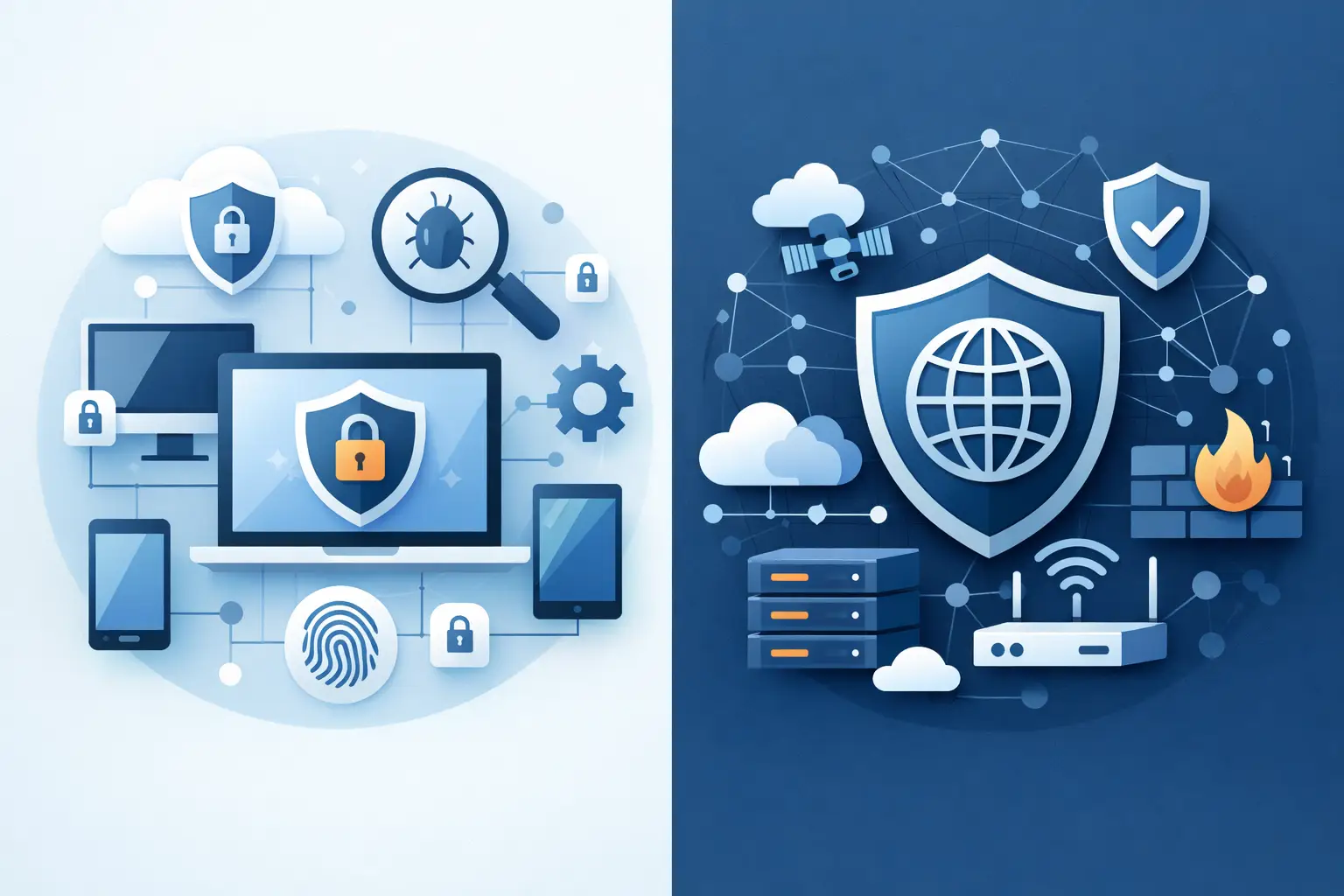
A simple way to think about it is this: endpoint security focuses on what happens on the device, while network security focuses on what moves between devices and systems. Both matter because attacks now cross back and forth between endpoints, cloud services, email platforms, and internal networks.
What endpoint security is responsible for
If an employee opens a malicious attachment on a company laptop, endpoint security is often the first line of defense. It can stop malware execution, isolate the machine, flag suspicious behavior, and help IT teams investigate what happened. Modern endpoint protection goes well beyond traditional antivirus. It often includes behavioral analysis, ransomware protection, device control, script monitoring, and response tooling.
This matters because the endpoint is where users work. It is where files are opened, credentials are entered, applications are installed, and email is accessed. If attackers compromise an endpoint, they often gain access to business data, internal communication, and cloud sessions that users already have open.
Endpoint security is especially important in environments with remote work, bring-your-own-device pressure, field teams, or multiple office locations. The more distributed the workforce becomes, the less effective it is to depend on the network perimeter alone.
That said, endpoint security has limits. If devices are unmanaged, if policies are inconsistent, or if alerting is not being monitored, protection can be uneven. Strong endpoint tools without disciplined patching, user support, and response processes still leave room for preventable incidents.
Common endpoint security controls
Endpoint security usually includes antivirus or next-generation antivirus, endpoint detection and response, patch management, device encryption, application control, and centralized policy enforcement. In managed environments, it should also include monitoring, alert review, and clear escalation when something suspicious appears.
What network security is responsible for
Network security controls who can connect, what traffic is allowed, and how systems are separated from one another. If endpoint security is about protecting the machine, network security is about limiting exposure and containing spread.
A properly secured network can block unauthorized access attempts, restrict risky traffic, segment critical systems, and reduce the chance that one compromised device leads to a wider outage. This is where firewalls, VLANs, access control lists, secure wireless design, DNS filtering, and VPN controls play a major role.
For businesses with servers, shared infrastructure, on-premises line-of-business systems, or multiple sites, network security is still foundational. It helps create order inside the environment. It also supports compliance, especially when sensitive systems need to be isolated from general user activity.
But network security also has limits. If a user works from home, connects from a personal network, or uses SaaS applications directly over the internet, the corporate network may not see much of that activity. Even inside the office, encrypted traffic and cloud-based workflows can reduce what perimeter tools can inspect. A strong firewall does not protect a device that is already compromised.
Why businesses need both
The real issue is not endpoint security vs network security as an either-or choice. It is whether your security model reflects how your business actually operates.
If your users work mostly in Microsoft 365, access cloud apps from anywhere, and move between office and remote settings, endpoint security becomes more important because the device travels with the user and the risk. If your business runs shared infrastructure, production networks, local servers, or multi-site connectivity, network security remains critical because the environment itself must be controlled and segmented.
Most businesses have both realities at once. Users are mobile, but systems are still interconnected. Data lives in the cloud, but identity, backup, printing, file access, and line-of-business applications still touch local infrastructure. That is why mature protection strategies layer endpoint and network security together instead of forcing one to compensate for the other.
Where companies get it wrong
One common mistake is assuming a firewall is enough. Firewalls are necessary, but they are not designed to replace endpoint controls. They can filter traffic and enforce rules, but they do not patch laptops, monitor suspicious processes, or isolate a workstation that starts encrypting files.
Another mistake is overinvesting in endpoint tools without addressing network design. If every system can talk freely to every other system, one compromised endpoint can create a much larger operational problem. Segmentation and access controls reduce blast radius.
The third issue is operational, not technical. Businesses buy tools, then fail to manage them consistently. Alerts are missed, exceptions pile up, devices fall behind on updates, and no one has clear ownership. Security gaps often come from unmanaged drift more than missing products.
How to decide where your biggest gap is
Start with exposure. If your team is highly mobile and relies on laptops, email, cloud applications, and remote access, endpoint security deserves close attention. That is where users interact with threats directly.
Then look at business continuity. If your operations depend on servers, site-to-site connectivity, shared applications, VoIP, or internal systems that cannot go down, network security has to be tightly controlled and monitored.
Finally, look at accountability. If endpoint tools, firewall management, Microsoft 365 administration, backups, and user support all sit with different vendors or internal owners, response will be slower when something goes wrong. Security is strongest when oversight is coordinated and changes are tracked across the full environment.
Signs your endpoint security needs work
Frequent patching delays, unmanaged laptops, inconsistent antivirus status, weak device visibility, and no clear process for isolating compromised systems are all signs of endpoint risk.
Signs your network security needs work
Flat networks, outdated firewall rules, weak VPN controls, poor wireless segmentation, and little visibility into unusual traffic are common indicators that network protection is behind.
The operational view that matters most
Decision-makers do not need a debate about tools. They need fewer incidents, faster containment, and less downtime when something does happen. That requires a managed approach.
Endpoint security and network security both generate signals. Those signals only create value if someone is watching them, responding to them, and tying them back to the systems users depend on every day. A well-managed environment connects monitoring, patching, support, backup readiness, and incident response so that security supports uptime instead of competing with it.
This is where a provider like One Source Datacom fits best – not as a product reseller, but as a single point of accountability across infrastructure, endpoints, Microsoft 365, and ongoing support. For businesses that cannot afford gaps between tools and ownership, that operating model matters as much as the controls themselves.
Endpoint security vs network security in practical terms
If you have to explain the difference internally, keep it simple. Endpoint security protects the devices your people use. Network security protects the environment those devices connect through. One reduces risk at the user and device level. The other reduces exposure and spread across the business.
Neither replaces the other. A secure endpoint on an open, poorly segmented network still creates risk. A well-defended network with unpatched, lightly managed devices still creates risk. The better question is whether your current setup can prevent common attacks, detect suspicious activity quickly, and keep an isolated issue from becoming a company-wide outage.
That is the standard worth using. If your security strategy supports uptime, limits disruption, and gives you a clear response path when something breaks, you are on the right track. If not, the next step is not buying more tools at random. It is building a tighter, better-managed security posture that matches how your business actually works.