
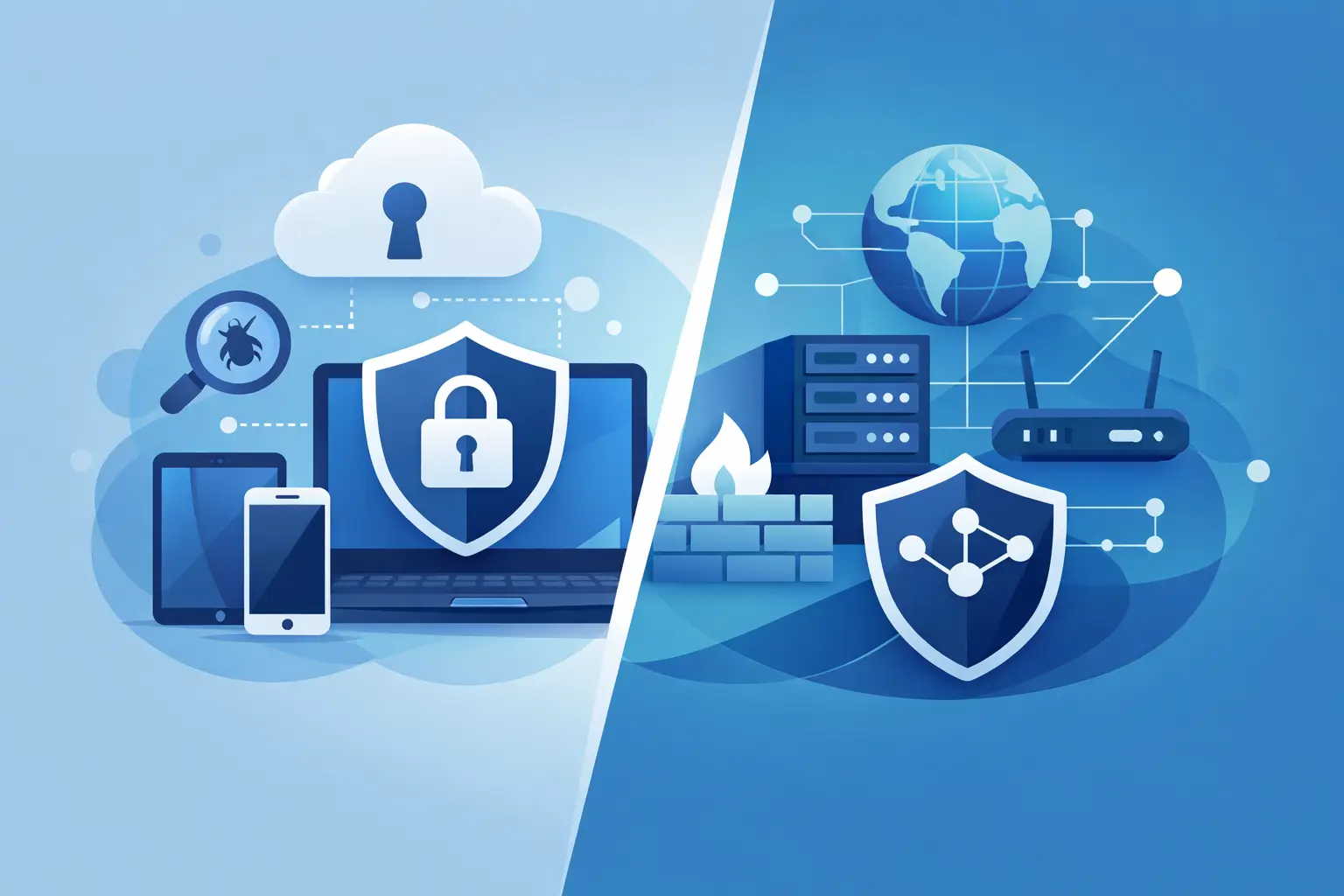
A phishing email lands in an employee inbox, gets opened on a company laptop, and starts reaching for shared files and cloud logins within minutes. That single event explains the difference between endpoint security and network security better than any textbook definition. One protects the device and user activity at the point of access. The other watches and controls the traffic, connections, and pathways that let threats move through the environment.
For businesses that rely on Microsoft 365, cloud apps, remote users, and always-on operations, this distinction matters. Security gaps rarely stay isolated. A missed patch on one workstation can become a broader incident if network controls are weak. At the same time, even a well-configured firewall cannot fully protect a laptop that is offsite, unmanaged, or already compromised.
What is the difference between endpoint security and network security?
Endpoint security is focused on individual devices such as laptops, desktops, servers, tablets, and sometimes mobile phones. Its job is to secure the systems people use every day by detecting malware, enforcing device policies, controlling applications, monitoring behavior, and keeping operating systems and software up to date.
Network security is focused on the infrastructure that connects users, devices, applications, and data. That includes firewalls, segmentation, intrusion prevention, secure remote access, DNS filtering, network monitoring, and policies that control what traffic is allowed in and out.
The simplest way to frame the difference is this: endpoint security protects the thing being used, while network security protects the environment those things communicate through. Both are necessary because modern attacks target both the device and the path.
Endpoint security protects the device, user, and local activity
Endpoints are where people work. They open email, log into business applications, download files, install software, and connect to shared systems. That makes endpoints one of the most common entry points for attackers.
A strong endpoint security program typically includes next-generation antivirus or endpoint detection and response, patch management, device encryption, administrative control, and policy enforcement. In practical terms, this means the business can identify suspicious behavior on a laptop, isolate a machine that may be compromised, block unauthorized software, and reduce the chance that a known vulnerability is left open.
This is especially important for hybrid and remote teams. A user working from home may never pass traffic through the office firewall. If the device itself is not protected, the company is depending on a network boundary that no longer represents how people actually work.
Endpoint security also helps with accountability. You can see which device is out of date, which user clicked a risky file, and which system needs immediate attention. For operations leaders, that visibility supports faster response and less downtime.
Network security protects traffic, access, and movement across systems
If endpoint security is about securing each front door, network security is about controlling the hallways, gates, and internal routes. It governs how devices connect, what services are exposed, which systems can talk to each other, and whether suspicious traffic is blocked before it spreads.
Common network security controls include firewalls, virtual private networks, secure Wi-Fi configuration, VLANs, intrusion detection and prevention, web filtering, and access control rules. These tools are designed to reduce exposure and limit lateral movement if a threat gets in.
That last point is where network security becomes critical. Not every incident starts with an external attack. Sometimes a compromised endpoint is the starting point. If the network is flat, poorly segmented, or loosely monitored, one infected device can reach file shares, line-of-business systems, or backup infrastructure much too easily.
Good network security creates containment. It also provides operational discipline by making traffic patterns visible. If a device starts making unusual outbound connections or trying to scan internal systems, the network layer may be the first place those behaviors are noticed.
Difference between endpoint security and network security in real business terms
For many decision-makers, technical definitions are less useful than operational impact. So here is the practical distinction.
Endpoint security reduces risk at the user and device level. It helps prevent malware execution, account misuse, unpatched vulnerabilities, and unsafe local behavior. It is closest to the employee, the workstation, and the day-to-day tools people use.
Network security reduces risk at the environment level. It helps control access, block unwanted traffic, enforce secure connections, and limit the spread of threats between systems. It is closest to the infrastructure, internet edge, internal connectivity, and the flow of data.
One is not a replacement for the other. If you invest only in endpoint tools, you may detect an infection but still allow it to communicate freely. If you invest only in network controls, you may miss the fact that a remote laptop is already compromised before it ever reconnects to the office.
That is why mature IT environments treat them as separate layers with shared objectives.
Where endpoint and network security overlap
There is some overlap, and that is where confusion often starts. Both categories can help detect threats, block malicious activity, and support response efforts. Some security platforms also blend capabilities, such as endpoint agents that report network behavior or firewalls that identify device-level anomalies.
But overlap does not mean sameness. The control point is different.
Endpoint tools act from the device outward. They can stop malicious processes, remove malware, enforce encryption, and isolate a specific machine.
Network tools act from the connection inward. They can restrict ports, segment systems, inspect traffic, block command-and-control activity, and prevent one area of the environment from affecting another.
The better question is not which category includes a certain feature. The better question is where you need visibility, where you need enforcement, and how quickly you can contain a problem when something goes wrong.
Which matters more for your business?
It depends on your environment, but most businesses should not frame this as an either-or decision.
If your workforce is highly mobile, heavily cloud-based, and spread across home offices or multiple sites, endpoint security becomes especially important because the device often operates outside the traditional network perimeter.
If your business runs critical servers, on-premises applications, shared storage, VoIP systems, or multi-site connectivity, network security carries more weight because availability and controlled access across infrastructure are central to operations.
In most cases, the right answer is both, with the level of investment shaped by business risk. A law firm handling sensitive documents, a manufacturer with multiple facilities, and a healthcare-adjacent office using Microsoft 365 all face different pressures. Compliance requirements, remote access needs, cyber insurance expectations, and downtime tolerance should influence the design.
What a balanced security approach looks like
A practical security strategy starts with acknowledging that users, devices, and networks are all active risk surfaces. The goal is not to buy every tool available. The goal is to put controls in the right places and manage them consistently.
That usually means endpoints are monitored, patched, encrypted, and protected with modern detection tools. It also means the network is segmented where appropriate, remote access is secured, internet traffic is filtered, and suspicious activity is logged and reviewed.
Just as important, someone has to own the ongoing work. Security drifts when policies are not maintained, alerts are ignored, and exceptions accumulate over time. Technology without oversight creates a false sense of control.
This is where a managed approach becomes valuable. When endpoint protection, patching, monitoring, user support, and network oversight are handled together, response becomes faster and accountability becomes clearer. One Source Datacom works with businesses that need exactly that kind of structured, always-on environment because uptime and security are operational requirements, not side projects.
The risk of treating security as a single tool
Many businesses still ask whether they need a firewall or antivirus, as if one product can cover the entire problem. That approach leaves blind spots. Attackers do not care how your budget categories are organized. They take advantage of weak devices, exposed services, stolen credentials, misconfigured remote access, and unmonitored traffic all at once if they can.
Security works better when it is layered, monitored, and tied to business continuity. Endpoint security and network security serve different functions, but they support the same outcome: keeping users productive, systems available, and incidents contained before they become business disruptions.
If you are evaluating your current setup, start with a simple question. If one employee device is compromised tomorrow, how quickly can you detect it, isolate it, and stop it from affecting anything else? Your answer will tell you a lot about whether your endpoint and network security are working together the way they should.
The strongest security posture is rarely the loudest. It is the one that keeps operations steady, closes obvious gaps, and gives your business a clear plan when something abnormal happens.