A ransomware alert at 2:00 a.m. is not a problem that can wait for the next business day. Neither is suspicious Microsoft 365 sign-in activity, an endpoint that suddenly begins communicating with an unknown host, or a critical vulnerability on an internet-facing server. For many organizations, security operations center outsourcing is the practical way to bring continuous security oversight to risks that do not follow office hours.
The value is not simply having someone watch a dashboard. A capable outsourced SOC helps an organization identify meaningful threats, investigate them in context, and move quickly when containment or remediation is required. Done well, it closes the gap between security tools that generate alerts and the operational team responsible for protecting the business.
But outsourcing a SOC is not a substitute for accountability. The right service model depends on your internal capability, regulatory requirements, technology environment, and tolerance for risk. Leadership should understand what the provider monitors, what actions it can take, and where the responsibility shifts back to the internal team.
What security operations center outsourcing provides
A Security Operations Center is the people, processes, and technology used to monitor, investigate, and respond to cybersecurity events. Building this internally requires around-the-clock staffing, specialized analysts, documented playbooks, threat intelligence, security platforms, and regular process improvement. For most small and mid-sized businesses, maintaining that capability in-house is expensive and difficult to staff consistently.
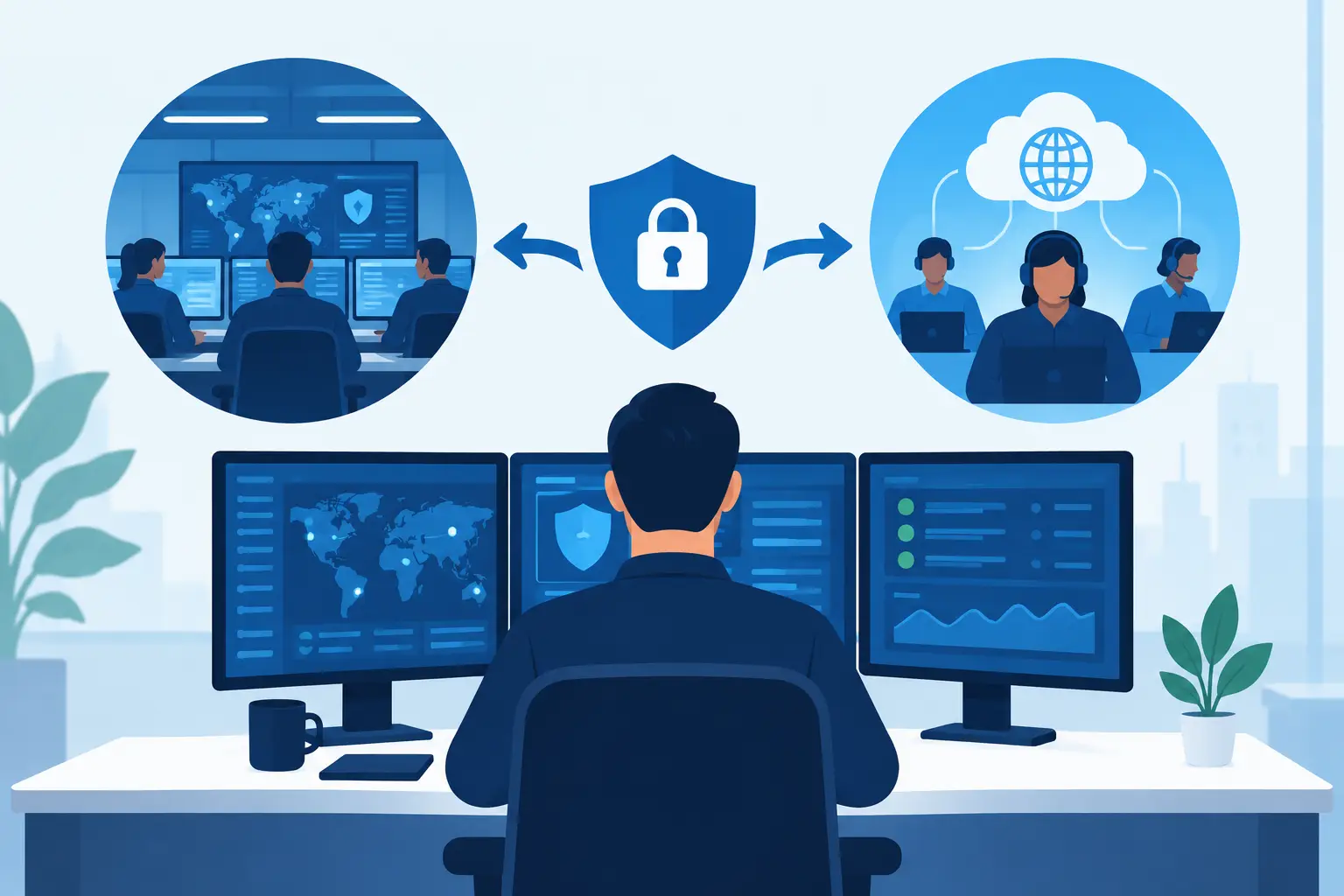
Security operations center outsourcing provides access to that operating model through a managed provider. The provider typically collects and correlates security data from endpoints, firewalls, identity platforms, cloud services, email systems, and other critical infrastructure. Analysts review alerts, separate routine activity from credible threats, and escalate incidents according to agreed procedures.
The business outcome is clearer visibility and faster decision-making. Instead of asking an internal administrator to sort through hundreds of low-value alerts, the organization receives prioritized information about events that may affect systems, data, users, or operations.
Monitoring is only the starting point
Continuous monitoring matters, but it is not the complete service. A useful SOC function includes investigation and response discipline. When an alert is triggered, the analyst should have enough telemetry and context to determine whether it is a false positive, a policy concern, or a genuine incident requiring action.
That distinction matters because alert volume can become its own operational risk. If every notification is treated as equally urgent, internal teams lose time and confidence. If alerts are ignored because there are too many, a real incident can remain active for hours or days.
A mature service should define how detections are reviewed, how severity is assigned, who receives notification, and what happens after escalation. This is where an outsourced SOC becomes an extension of IT operations rather than another disconnected vendor sending email alerts.
When an outsourced SOC makes sense
Outsourcing is often a strong fit for organizations that have essential systems but lack a fully staffed internal security team. This includes multi-site offices, companies with remote and hybrid users, businesses handling regulated or sensitive data, and organizations that rely heavily on Microsoft 365, cloud applications, endpoints, servers, and VPN access.
It is especially relevant when an internal IT team is already responsible for user support, projects, patching, vendor coordination, backups, and day-to-day infrastructure maintenance. Those responsibilities are important, but they can leave little time for after-hours threat monitoring and detailed security investigation.
An outsourced model can also help organizations that have already invested in endpoint protection, email security, firewalls, or identity controls but are not receiving the full value from those tools. Security platforms produce data. A SOC creates a process for reviewing that data and acting on it.
The model is not always the right answer by itself. Larger enterprises with dedicated internal security teams may need co-managed SOC support rather than full outsourcing. In that arrangement, the provider supplies 24/7 coverage, tooling, and specialized analysis while the internal team retains more direct control over investigations and response decisions.
Define the scope before selecting a provider
Not all SOC services deliver the same level of coverage. Some providers monitor a limited set of alerts and notify the customer when a threshold is met. Others provide deeper investigation, guided remediation, threat hunting, incident coordination, and direct response actions. The difference has a direct effect on risk, cost, and internal workload.
Before engaging a provider, identify the systems that need coverage. For many businesses, the priority includes endpoints, Microsoft 365 identities and email, firewall and VPN activity, servers, cloud workloads, backup systems, and privileged accounts. The right scope depends on where business-critical data lives and how users access it.
It is also necessary to define service boundaries. Can the provider isolate a compromised endpoint? Can it disable a suspicious user account? Can it block a malicious domain or firewall connection? Or must it contact an authorized employee and wait for approval? There is no universal answer, but the expectation must be documented before an incident occurs.
A service that only notifies may be appropriate for a business with an experienced internal security team available at all hours. For a lean IT department, a model that includes managed detection and response may be more practical because it reduces the time between detection and containment.
Questions that reveal operational maturity
The best conversations move beyond a list of security tools. Ask how alerts are triaged, what evidence is included in an escalation, and how the provider measures time to acknowledge, investigate, and contain an incident. Ask whether analysts work from documented response playbooks and how those playbooks are tailored to your environment.
Also ask what happens after an incident is closed. A useful partner should help identify the root cause, recommend corrective actions, and improve controls where needed. That may involve patching an exposed system, strengthening multifactor authentication, revising user access, adjusting email protections, or correcting a backup gap.
Reporting deserves similar attention. Leadership needs concise, usable information: notable threats, response activity, unresolved risks, control gaps, and trends that may require investment. A monthly report filled with raw alert counts does not provide operational clarity.
Integration with managed IT determines the outcome
Security monitoring works best when it is connected to the teams managing the environment. A SOC analyst may identify a compromised endpoint, but someone must isolate it, preserve evidence, reset credentials, verify backups, remove persistence, and confirm the device is safe to return to service.
Fragmented providers can slow that process. One vendor monitors alerts, another manages the firewall, a third handles Microsoft 365, and an internal employee is expected to coordinate the response. During a real incident, unclear ownership can add avoidable delays.
A unified managed service approach brings security operations together with infrastructure oversight, endpoint management, patching, backup and disaster recovery, and user support. This does not eliminate the need for defined roles, but it gives the business a clearer path from detection to remediation. One Source Datacom approaches security as part of the larger operating environment, where availability, support, and protection must work together.
That integration also improves prevention. Repeated login attempts may lead to an access-policy review. A security event tied to an unpatched device can trigger a patching correction. A compromised mailbox can prompt better identity controls and targeted user awareness training. Security outcomes improve when lessons from incidents are applied to the systems that caused or enabled them.
Avoid common outsourcing mistakes
The most common mistake is treating outsourced monitoring as a finished security strategy. A SOC can identify threats, but it cannot compensate for unmanaged endpoints, weak passwords, missing multifactor authentication, unsupported systems, unreliable backups, or excessive user permissions. The service needs a stable security foundation.
Another mistake is assuming 24/7 monitoring means 24/7 remediation. Read the service definition closely. Notification, investigation, containment, and recovery are separate activities. Each should have a clear owner, escalation path, and expected response time.
Finally, avoid selecting solely on the lowest monthly price. Inexpensive monitoring that produces vague alerts or requires your team to perform all investigation may create more work than it removes. The more meaningful comparison is the level of coverage, analyst involvement, response authority, integration with your IT environment, and ability to support business continuity.
Build a service model around business risk
Security operations center outsourcing should be evaluated as an operational decision, not just a cybersecurity purchase. Start with the systems your business cannot afford to lose, the data that requires protection, and the staff members who would be responsible if an incident occurred overnight. Then build response procedures that match that reality.
The goal is not to create more alerts or add another vendor relationship. It is to ensure that when a credible threat appears, the right people have the information, authority, and technical support to contain it before it becomes business disruption. A focused assessment of current monitoring, response roles, and security gaps is a practical next step for any organization that needs that level of control.