A server outage at 2:00 a.m., a suspicious Microsoft 365 sign-in, or a failed backup is not an abstract IT concern. It is an operational interruption with real cost. The managed IT versus internal team decision comes down to who is accountable for seeing those issues early, responding quickly, and preventing the next one.
For many businesses, the question is not whether internal IT has value. It does. The better question is whether the current support model provides enough coverage, security depth, and operational discipline for the organization’s actual risk.
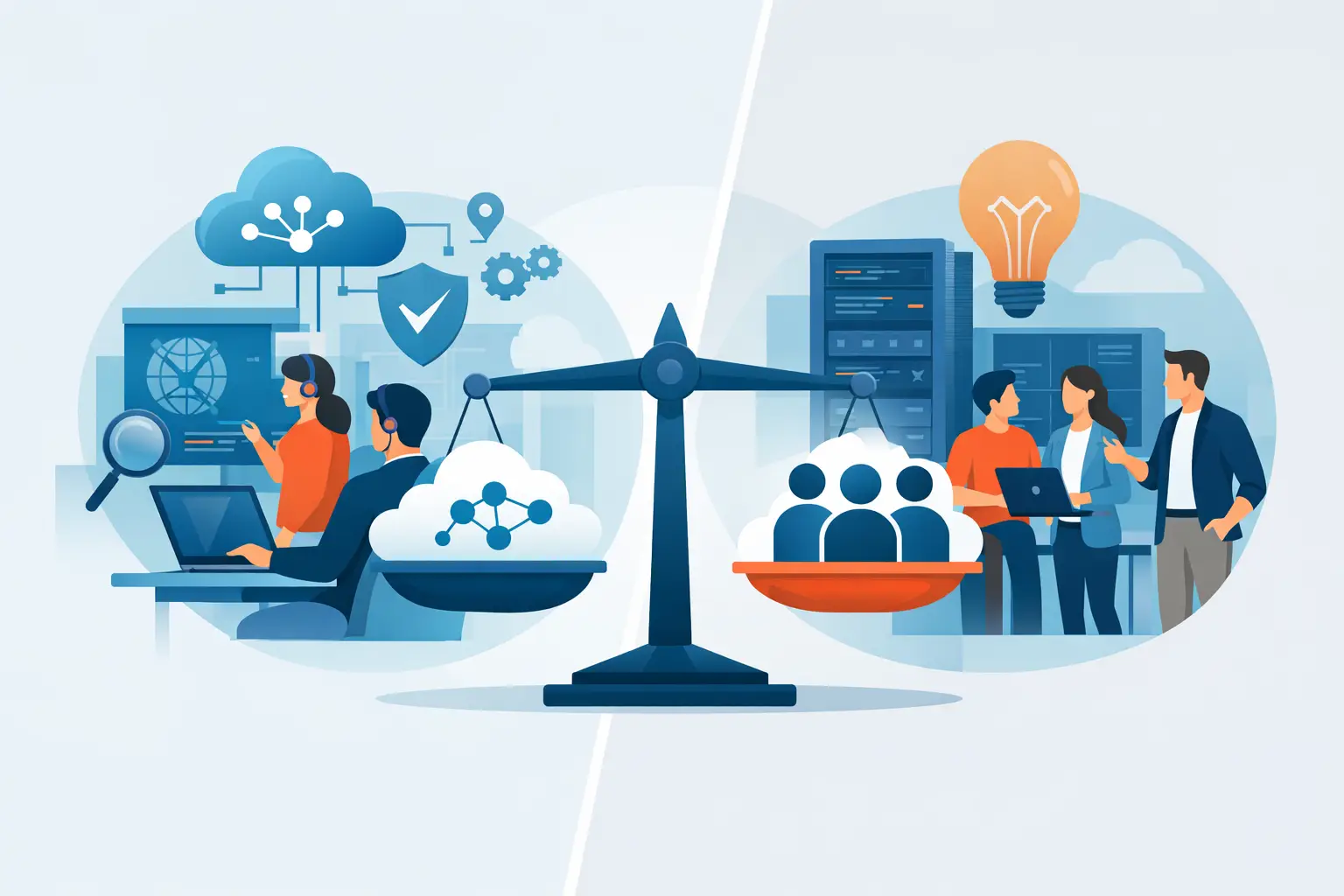
Managed IT Versus Internal Team: The Core Difference
An internal IT team is employed directly by the business. That team may handle user support, systems administration, vendor coordination, cybersecurity, infrastructure projects, and planning. The model provides close familiarity with company processes and direct access to staff and leadership.
Managed IT services place day-to-day technology operations under an external provider with defined responsibilities, service levels, tools, and reporting. A managed provider typically monitors systems around the clock, handles helpdesk requests, applies patches, manages endpoint security, administers Microsoft 365, and verifies backup and recovery readiness.
The difference is not simply internal versus external. It is the operating model. Internal teams often have to balance strategic projects with urgent support requests. A managed IT partner is built to run recurring operational tasks consistently, using standardized processes and shared technical resources.
Neither model is automatically right for every business. A company with a large, specialized technology environment may need a substantial internal department. A growing organization with 40, 100, or 300 users may gain better coverage and predictability through managed support. Many businesses need a combination of both.
Where Internal IT Delivers the Most Value
Internal IT is especially valuable when technology is central to the company’s product, intellectual property, or daily operating model. A dedicated internal team develops institutional knowledge that is difficult to replicate quickly. They understand departmental workflows, business priorities, custom applications, and the political realities behind a technology decision.
They are also well positioned to lead long-term initiatives. Examples include integrating an acquired company, replacing a line-of-business platform, modernizing a data environment, or supporting highly specialized equipment. These efforts require close coordination with leaders and users, not just ticket resolution.
However, the internal model can become fragile when it relies on one or two people. If the network administrator is also the helpdesk lead, Microsoft 365 administrator, cybersecurity contact, backup owner, and after-hours escalation point, important work competes for limited attention. Documentation may fall behind. Patching can be delayed. Alerts may go unseen outside business hours.
The issue is not capability. It is capacity and coverage. Even a highly skilled IT manager cannot provide 24/7 monitoring, incident response, project delivery, vendor management, and daily user support without a disciplined support structure behind them.
Where Managed IT Creates Operational Control
Managed IT is designed around repeatable oversight. Monitoring tools watch endpoints, servers, networks, backups, and key services. Alerts are triaged before they become user-facing problems whenever possible. Helpdesk teams handle common requests, while escalation paths bring in deeper expertise when an issue requires it.
That structure matters because many business disruptions begin as small, preventable failures: a disk filling up, an expired certificate, an unpatched device, repeated failed sign-in attempts, or a backup job that has not completed. Reactive break-fix support may address these after an outage. Managed oversight is intended to identify and resolve them earlier.
A managed provider also creates broader coverage than a small internal team can usually maintain alone. Depending on the agreement, the business may have access to network specialists, security personnel, cloud administrators, and backup and recovery resources without hiring each role individually.
For organizations dependent on Microsoft 365, this can include user lifecycle management, account security, licensing oversight, mailbox support, conditional access administration, and response to compromised accounts. When these responsibilities are fragmented across office managers, outside consultants, and internal staff, accountability becomes unclear. A managed service model brings them into a defined operating process.
Compare Cost Beyond Salary
The cost comparison is often framed too narrowly. An internal IT employee’s salary is only one part of the expense. Recruiting, benefits, training, certifications, management time, coverage during absences, software tools, monitoring platforms, security products, and outside specialists all add to the total.
Managed IT usually converts much of that variable cost into a predictable monthly service fee. This makes budgeting easier, but predictability should not be confused with low cost in every circumstance. A provider that includes 24/7 monitoring, helpdesk support, patching, endpoint protection, backup oversight, and Microsoft 365 administration may cost more than a basic remote support contract. The scope matters.
The more useful financial question is this: what does downtime cost the business? Consider lost employee productivity, delayed customer service, missed transactions, overtime, reputational harm, and recovery expenses after a security incident. A lower-cost support model can become expensive when it leaves gaps in monitoring, backup validation, or incident response.
Security Is a Coverage Problem
Cybersecurity requires more than installing antivirus software. It depends on timely patching, endpoint visibility, identity controls, secure configuration, user access management, backup protection, and an escalation process when suspicious activity appears.
An internal team can manage these controls effectively if it has the people, tools, and time. The challenge is that security work is continuous. New vulnerabilities, phishing attempts, compromised credentials, and configuration changes do not wait for quarterly reviews or open calendar time.
Managed IT can improve security posture by making routine controls part of daily operations. Endpoint security alerts can be reviewed, patches can be scheduled and verified, inactive accounts can be removed, and backup jobs can be monitored. For businesses with greater exposure or compliance obligations, managed detection and response, Security Operations Center support, and compliance-focused security services can add another layer of oversight.
Still, outsourcing IT does not outsource executive responsibility. Business leaders must approve policies, define acceptable risk, support security training, and ensure the provider has the authority and information needed to act quickly. Effective security is a shared responsibility with clearly assigned ownership.
The Hybrid Model Often Makes the Most Sense
The choice does not have to be all or nothing. A hybrid structure lets internal IT focus on business-specific systems, projects, and leadership alignment while a managed provider handles recurring operations and after-hours coverage.
For example, an internal IT manager may own application strategy, vendor relationships, and site expansion planning. The managed partner can provide helpdesk support, endpoint management, patching, monitoring, backup oversight, security operations, and escalation coverage. This reduces the risk that strategic work is constantly interrupted by password resets, device issues, and routine maintenance.
The model works only when responsibilities are documented. Who owns user onboarding? Who approves access? Who responds to a security alert? Who tests disaster recovery? Who communicates during an outage? Ambiguity between an internal team and an outside provider creates the same delays as having no defined support process at all.
Questions to Ask Before You Choose
Start with operating reality, not preference. Review the last 12 months of outages, recurring tickets, security incidents, failed backups, delayed projects, and after-hours issues. If the organization cannot clearly answer who monitors critical systems, who verifies recovery, and who owns incident response, there is a coverage gap.
Then evaluate the internal team’s workload. Are skilled employees spending most of their time on repetitive support? Are security and maintenance tasks consistently completed? Is there documented coverage when a key person is unavailable? These answers will show whether the business needs more internal capacity, managed support, or both.
Also examine the provider’s actual service scope. Ask how monitoring works, what is included in helpdesk coverage, how patches are verified, how backup failures are handled, how security incidents are escalated, and what reporting leadership receives. A managed agreement should create measurable accountability, not simply provide a number to call when something breaks.
One Source Datacom approaches managed services as an operational commitment: maintaining infrastructure health, supporting users, and addressing security risks through structured, ongoing oversight. That is the standard businesses should expect from any technology partner.
The right model is the one that gives your business clear ownership before an issue becomes an outage. Build around the systems your employees and customers depend on, define who is responsible at every stage, and make sure support coverage matches the cost of being unavailable.