When a server issue hits at 8:15 a.m. and your team cannot access Microsoft 365, the debate around in house IT vs managed services stops being theoretical. It becomes an operations problem, a security problem, and in many cases a revenue problem. For businesses that rely on stable systems every day, the right IT model is less about preference and more about whether support, oversight, and accountability are in place before something breaks.
The real question is not which model sounds better on paper. It is which approach gives your organization the coverage, security, responsiveness, and structure required to keep business moving.
In house IT vs managed services: the core difference
An in-house IT model means your company hires internal staff to handle support, infrastructure, user management, security tasks, and technology planning. That can range from one generalist managing everything to a full department with specialists.
A managed services model means an outside provider takes responsibility for defined IT functions under an ongoing agreement. That often includes 24/7 monitoring, helpdesk support, patching, endpoint protection, backup oversight, Microsoft 365 administration, and incident response. Instead of waiting for something to fail and then calling for help, the model is built around active management.
This distinction matters because most business risk in IT does not come from a single major event. It comes from small gaps that go unmanaged – missed patches, weak endpoint controls, poor alert visibility, inconsistent backups, and user issues that drag on longer than they should.
Where in-house IT works well
There are situations where internal IT is the right fit. If your company has enough scale to support multiple dedicated roles, in-house staff can provide strong alignment with internal processes and day-to-day business needs. They know your users, your systems, and the operational priorities that shape decisions.
An internal team can also be a good fit when your environment is highly specialized. Manufacturing systems, line-of-business applications, or regulated workflows sometimes require deep internal familiarity that takes time to build. In those cases, proximity to the business can be a real advantage.
Control is another reason companies lean toward internal hiring. Some leaders prefer direct oversight of staff, tools, and priorities. If IT decisions are tightly tied to product development, internal operations, or site-specific infrastructure, that model may feel more direct and easier to manage.
But there is a limit to how far one or two internal employees can stretch. That is usually where the model starts to weaken.
The pressure points of an in-house team
The biggest challenge with in-house IT is not competence. It is coverage. A capable internal administrator can still only handle so much. Support requests, cybersecurity tasks, vendor coordination, backups, patching, new user setup, Microsoft 365 administration, and long-term planning all compete for the same hours.
That creates risk in three areas.
First, there is limited availability. Internal staff work business hours, take vacation, get sick, and can only be in one place at a time. If your business operates across locations or needs support outside a standard schedule, the gaps become obvious.
Second, there is limited specialization. Modern IT requires more than general troubleshooting. Security monitoring, compliance support, cloud administration, identity management, backup validation, and incident response all demand focused attention. Hiring one person to do all of that rarely produces consistent results.
Third, there is key-person dependency. When one employee holds most of the knowledge, turnover becomes a serious operational issue. Documentation is often incomplete, vendor relationships may sit with one individual, and response slows down when that person is unavailable.
For businesses that cannot tolerate downtime, these are not minor concerns. They affect continuity, risk exposure, and how quickly normal operations can be restored.
Where managed services stand out
Managed services are designed to solve the coverage problem. Instead of depending on one internal resource to carry the full load, businesses gain access to a broader operational structure. That structure usually includes monitoring platforms, documented processes, support workflows, and multiple layers of technical accountability.
The most immediate advantage is continuity. Systems are monitored around the clock, alerts are reviewed, routine maintenance is scheduled, and user issues move through a support process instead of sitting in one person’s inbox. That reduces reactive firefighting and gives leadership better visibility into what is being managed.
Security is another major factor. Many businesses assume they are protected because they have antivirus and backups in place. In practice, security depends on many connected actions – patching, endpoint controls, access management, email security, backup monitoring, incident escalation, and policy enforcement. Managed services can bring those functions together under one operating model instead of leaving them fragmented.
That operational discipline is often where the biggest value appears. A provider is not simply available when something breaks. The provider is accountable for maintaining the environment, reducing preventable issues, and creating a clearer support structure for users and leadership.
Cost is not as simple as salary vs contract
Cost comparisons between in house IT vs managed services are often oversimplified. Decision-makers tend to compare a salary to a monthly service fee, but that leaves out the full operating picture.
An internal hire comes with salary, benefits, recruiting time, training, management overhead, and tool costs. If you need after-hours coverage, security support, backup oversight, cloud expertise, or compliance guidance, those costs rise quickly. In many cases, companies end up layering contractors or vendors on top of internal staff anyway.
Managed services typically shift IT spending into a more predictable monthly model. That does not mean cheaper in every case. A mature internal department may be the better fit for a large organization with heavy internal demands. But for many small and mid-sized businesses, managed services offer broader support coverage than they could realistically build on their own.
The better financial question is this: what level of uptime, security, and response does the business require, and what does it cost to achieve that reliably?
Control, accountability, and the concern leaders often raise
Some executives hesitate to outsource IT because they worry about losing control. That concern is understandable, especially if prior vendors were slow, vague, or only showed up after failures.
A well-structured managed services relationship should do the opposite. It should create clearer accountability. Roles are defined, service responsibilities are documented, monitoring and support are structured, and escalation paths are established. Instead of relying on informal knowledge and ad hoc fixes, the business gets a repeatable operating model.
Control does not come from having every function under your roof. It comes from knowing who owns what, how issues are handled, what protections are in place, and whether the environment is being actively managed.
The hybrid option is often the practical answer
For many businesses, the decision is not strictly internal or outsourced. A hybrid model can make the most sense.
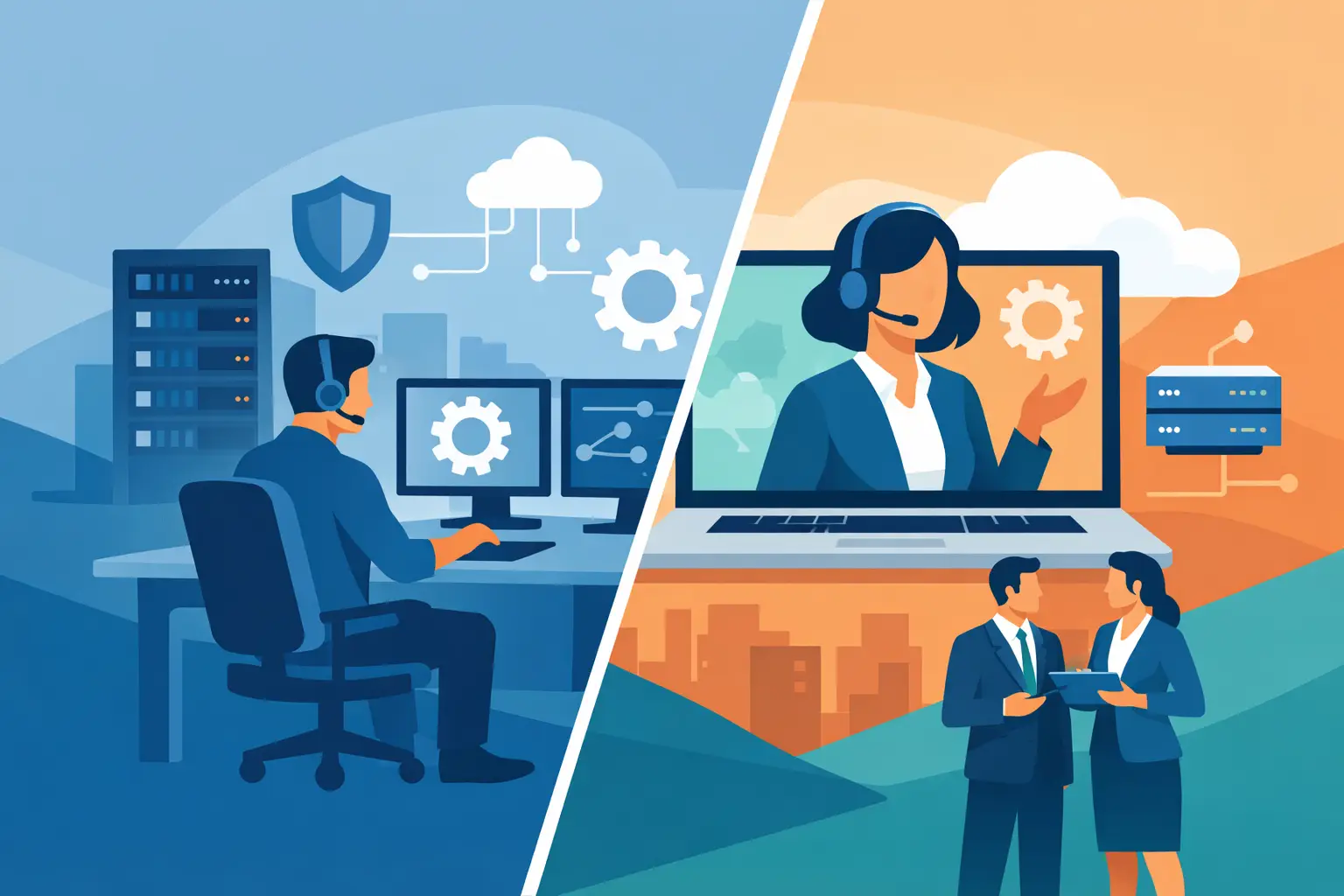
In this setup, internal staff stay close to business applications, projects, and on-site needs, while a managed services provider handles monitoring, helpdesk overflow, cybersecurity controls, patching, backup oversight, and Microsoft 365 administration. This gives the organization internal familiarity without forcing one person or a small team to absorb every operational demand.
It is also a strong option for growing companies. Instead of waiting until the environment becomes unstable or the internal team burns out, leadership can add managed support where risk is increasing fastest.
That is often the turning point. Businesses do not move toward managed services because internal IT failed. They do it because the environment became too important, too distributed, or too security-sensitive to manage informally.
How to decide between in-house IT vs managed services
Start with business impact, not preference. If your systems go down, how quickly does it affect staff productivity, customer service, revenue, or compliance? If the answer is immediately, your support model needs real depth.
Then look at your current coverage. Who is watching alerts after hours? Who verifies backups? Who handles security events, patching exceptions, Microsoft 365 administration, and user support when your primary IT person is unavailable? If those answers are unclear, the risk is already present.
Finally, look at accountability. Are you buying occasional fixes, or do you have a structured service model that is responsible for keeping the environment healthy? That difference shapes uptime more than most organizations realize.
For companies that need consistency, visibility, and stronger operational control, managed services often provide a more dependable path than relying on limited internal bandwidth alone. Providers like One Source Datacom are built around that model – proactive oversight, responsive support, and security woven into daily IT operations rather than treated as a separate project.
The right choice is the one that keeps your business stable on ordinary days and resilient on bad ones.