
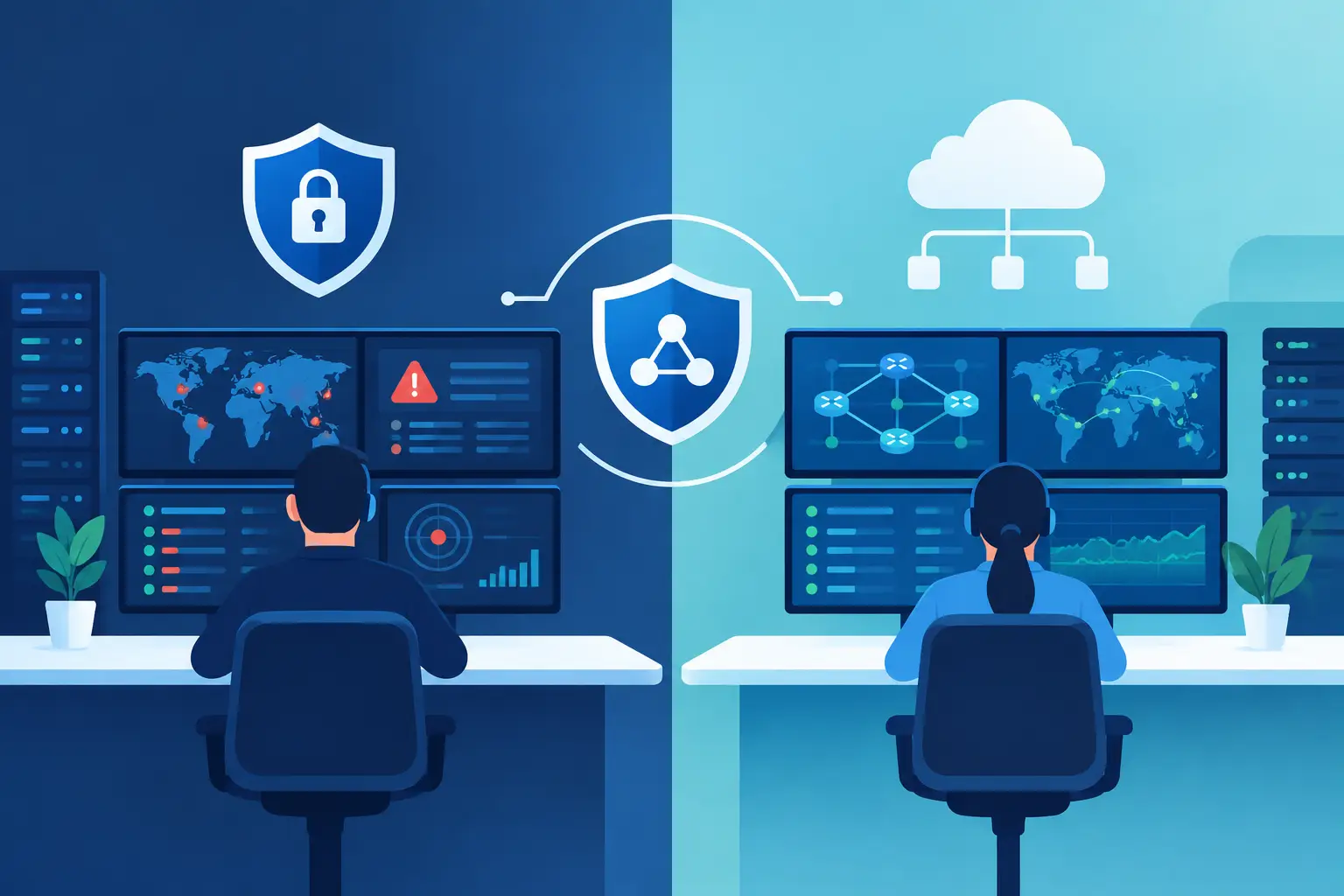
A server can be online while your business is still exposed. A phishing campaign can be contained while users still cannot access a critical application. That is why the question of SOC vs NOC services matters to organizations that depend on stable systems, secure data, and fast response when something goes wrong.
Both services provide continuous monitoring, but they solve different operational problems. A Network Operations Center, or NOC, keeps infrastructure available and performing as expected. A Security Operations Center, or SOC, watches for cyber threats, suspicious activity, and security incidents. Understanding the difference helps business leaders invest in the coverage that protects their actual risks rather than paying for overlapping tools without clear accountability.
SOC vs NOC Services: Different Missions, Shared Goals
The NOC is focused on operational health. Its job is to identify and address issues that could interrupt normal IT services, such as a failed backup, an offline server, a network outage, low disk space, or a connectivity problem at a branch location. NOC monitoring is built around uptime, performance, capacity, and reliability.
The SOC is focused on security health. Its job is to detect, investigate, and respond to threats that could compromise systems, accounts, or data. That may include unusual sign-in attempts, malware activity, unauthorized changes, suspicious email behavior, or signs that an attacker is moving through the environment.
The two teams may look at some of the same systems, but they ask different questions. A NOC asks, “Is this system working?” A SOC asks, “Is this system being misused or attacked?” For a business that relies on Microsoft 365, cloud applications, endpoints, servers, and remote users, both questions are necessary.
What NOC Services Cover
NOC services are designed to keep the technology environment running. This often includes 24/7 monitoring and alerting for networks, servers, workstations, firewalls, cloud resources, and backup systems. When an alert occurs, the NOC validates the issue, follows established response procedures, and escalates or resolves it before it becomes a larger interruption.
For example, a NOC may identify that a server is reaching storage capacity, a network circuit is unstable, or backup jobs have failed for two consecutive nights. These are not always security events, but each can create serious business disruption if ignored. Early detection gives the IT team time to correct the issue in a controlled way instead of responding after users are already affected.
NOC coverage also supports preventive maintenance. Patching, device health checks, performance monitoring, and asset visibility help reduce the number of avoidable service tickets. The goal is not simply to react faster. It is to reduce the conditions that cause downtime in the first place.
What SOC Services Cover
SOC services focus on the signals that may indicate a security threat. Security analysts review alerts from endpoint protection, identity platforms, firewalls, email security tools, cloud applications, and other security controls. They determine whether activity is expected, suspicious, or clearly malicious.
A SOC may investigate repeated failed logins from an unfamiliar location, a user account creating unexpected mailbox forwarding rules, or an endpoint attempting to connect to known malicious infrastructure. If the event is confirmed as a threat, the response may include isolating a device, disabling an account, blocking a connection, collecting evidence, and coordinating remediation.
The value of a SOC is not just alert volume. Most organizations already receive more security notifications than their internal teams can reasonably review. A capable SOC adds analysis, triage, escalation discipline, and incident response procedures so meaningful threats do not get buried among routine alerts.
Where NOC and SOC Responsibilities Overlap
Operational issues and security incidents often affect the same technology. A firewall outage is a NOC concern because connectivity may fail. A firewall configuration change made by an unauthorized user is a SOC concern because it may expose the network. A ransomware event may begin as a SOC incident, then become a NOC priority when systems require restoration and business operations need to be stabilized.
This overlap makes coordination critical. When the NOC, SOC, helpdesk, backup team, and infrastructure administrators operate separately without defined handoffs, important details can be lost. The security team may contain an incident but not know which business systems are most urgent to restore. The operations team may resolve a service interruption without recognizing that the root cause was malicious activity.
A unified managed IT approach provides a clearer chain of responsibility. Security findings can trigger operational actions, and operational alerts can be reviewed for potential security implications. That coordination reduces delay during events when every minute matters.
How to Decide Which Service You Need
The right answer depends on your environment, your risk exposure, and your internal capabilities. Businesses with limited IT resources often need baseline NOC oversight first because an unmanaged infrastructure environment creates immediate uptime and support problems. If systems are not monitored, patched, backed up, and maintained, security tools alone will not provide dependable business continuity.
However, NOC services are not a substitute for security operations. A NOC can alert you that an endpoint is offline, but it may not determine whether the endpoint was taken offline by malware. It can identify a network performance issue, but it is not necessarily responsible for investigating whether unusual traffic indicates data exfiltration.
SOC coverage becomes increasingly necessary when a business has sensitive data, remote access, Microsoft 365 users, compliance obligations, cyber insurance requirements, or a growing number of endpoints and cloud services. It is also appropriate when internal staff lack the time or specialized knowledge to investigate security alerts around the clock.
Consider both SOC and NOC services if your organization faces any of these conditions:
- Multiple offices, remote employees, or systems that must remain available outside business hours.
- A high dependence on Microsoft 365, cloud applications, line-of-business systems, servers, or connected devices.
- Cyber insurance, regulatory, customer, or contractual expectations for documented security monitoring and response.
- An internal IT team that needs operational support and security escalation coverage without adding a full 24/7 staff.
For many small and mid-sized businesses, the best model is not choosing one over the other. It is establishing the appropriate level of both services based on business impact. A company with a small, low-risk environment may need focused infrastructure monitoring and practical endpoint security. A multi-site organization handling financial, legal, healthcare, or customer data may need continuous NOC oversight, managed detection and response, identity monitoring, backup verification, and documented incident procedures.
What to Look for in a Managed Provider
The service label alone does not tell you what is included. Some providers use “NOC” to describe simple device alerting. Others include active remediation, patch management, backup monitoring, vendor coordination, and escalation. Likewise, some SOC offerings send notifications, while others provide analyst-led investigation and actions to contain verified threats.
Ask direct questions about monitoring hours, response expectations, escalation paths, and who owns remediation. You should also understand which tools are included, how alerts are prioritized, and whether the provider can coordinate across your network, endpoints, Microsoft 365 tenant, backups, and users. Clear scope prevents the common problem of receiving an alert but having no one accountable for resolving the underlying issue.
One Source Datacom approaches managed services as an integrated operating model: infrastructure oversight, user support, endpoint protection, backup and recovery, cloud administration, and security response work together to support continuity. That structure gives decision-makers a single accountable partner rather than a collection of disconnected vendors.
Build Coverage Around Business Impact
The practical goal is not to add monitoring for its own sake. It is to make sure someone is watching the systems that keep your business running and the threats that could take them down. NOC services protect availability. SOC services protect confidentiality, integrity, and security response. Together, they create the operational discipline needed to keep problems small, recover faster, and make IT risk easier to manage.
Start by identifying the systems your teams cannot operate without, the data that would cause the greatest harm if exposed, and the alerts no one is currently equipped to investigate. Those answers will point to the service coverage your business needs next.