A ransomware alert at 2:13 a.m. is where MDR vs antivirus protection stops being a product comparison and becomes an operational decision. If no one is watching, triaging, and containing the threat, the fact that antivirus was installed may not matter much by 8:00 a.m. when your team logs in and finds systems encrypted, accounts compromised, or Microsoft 365 activity under review.
For many businesses, antivirus is still treated as the default answer to endpoint security. It is familiar, affordable, and better than having no protection at all. But the threat landscape has changed. Attackers now use stolen credentials, script-based attacks, living-off-the-land tools, and techniques designed to bypass traditional signature-based defenses. That is why the real question is not whether antivirus has value. It does. The question is whether antivirus alone is enough for an organization that depends on uptime, cloud access, remote users, and fast recovery when something goes wrong.
What antivirus does well
Antivirus is designed to detect and block known malicious files, suspicious behavior, and common malware patterns on individual devices. Modern antivirus and endpoint protection products are more capable than older versions. They often include behavioral analysis, web filtering, and basic ransomware controls.
That makes antivirus a useful foundational control. It can stop commodity malware, prevent some malicious downloads, and reduce exposure from everyday threats. For smaller environments with low complexity, limited regulatory pressure, and very tight budgets, antivirus may cover part of the risk picture.
The limitation is not that antivirus is ineffective. The limitation is scope. Antivirus is focused on prevention at the endpoint. It is not a full security operation, and it does not replace ongoing oversight, investigation, or guided response when alerts turn into incidents.
MDR vs antivirus protection: the core difference
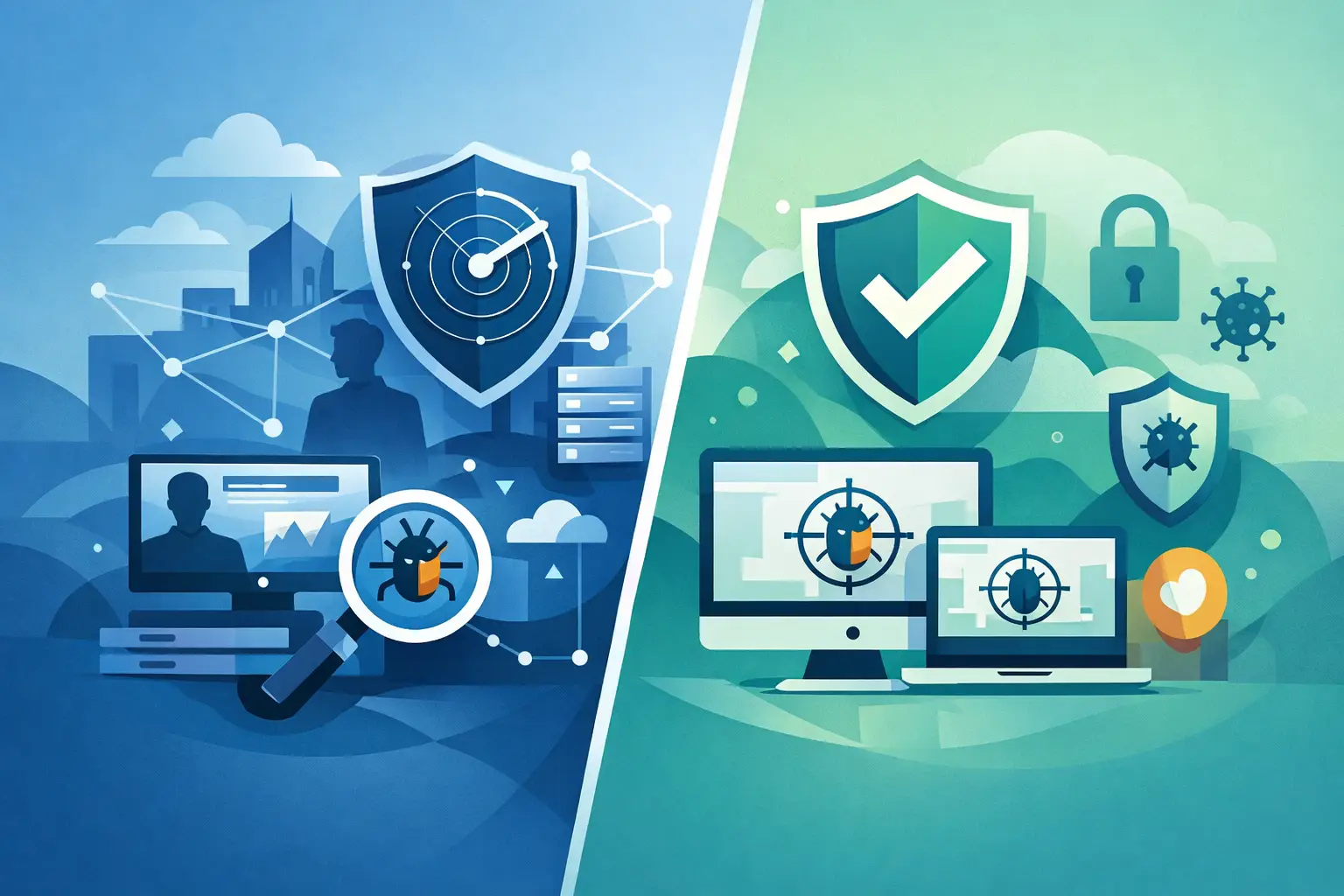
The simplest way to understand MDR vs antivirus protection is this: antivirus is a tool, while MDR is a managed security service built around detection, investigation, and response.
MDR, or Managed Detection and Response, combines endpoint telemetry, threat monitoring, analysis, and active response by security professionals. Instead of just generating alerts, MDR is built to evaluate what those alerts mean, determine whether a threat is real, and take action to contain it.
That difference matters in business environments where alerts happen outside business hours, internal IT resources are limited, or there is no in-house security team dedicated to incident handling. Antivirus may flag suspicious activity. MDR is designed to answer the next questions: Is this malicious? How far has it spread? Which user accounts or systems are affected? What needs to be isolated right now?
Where antivirus alone usually falls short
Most security gaps are not caused by the absence of software. They are caused by the absence of monitoring, context, and response discipline.
An antivirus platform can log a detection, quarantine a file, or warn about abnormal behavior. But if the attacker used valid credentials, moved laterally through remote tools, or launched activity through PowerShell, the event may not look like a simple malware infection. In those cases, someone has to correlate activity across systems, review timelines, assess business impact, and decide on containment.
This is where many organizations run into trouble. They have tools in place, but no structured process for reviewing alerts around the clock. Internal IT teams are often focused on user support, system maintenance, vendor coordination, and business projects. Asking the same team to function as a 24/7 security operations group is rarely realistic.
Antivirus also tends to be weaker when the threat is persistent rather than immediate. A low-and-slow compromise, suspicious sign-in behavior, or repeated endpoint anomalies may not trigger an obvious block event. Without active monitoring and investigation, a threat can stay in the environment longer than leadership realizes.
What MDR adds to the security stack
MDR adds oversight, expertise, and response capability. That changes the outcome when threats get past preventive controls.
A managed detection and response service typically monitors endpoints continuously, investigates suspicious activity, escalates verified incidents, and helps contain threats before they affect more users or systems. Depending on the provider and service model, response may include isolating endpoints, stopping malicious processes, disabling risky access, and coordinating remediation steps.
This is especially valuable for businesses that rely on Microsoft 365, remote endpoints, line-of-business applications, and cloud-connected workflows. Threat activity does not stay neatly on one laptop anymore. A compromised account can affect email, file access, user sessions, and collaboration tools quickly. MDR gives businesses a layer of human-led oversight that antivirus by itself does not provide.
MDR vs antivirus protection for SMBs and mid-sized firms
Some business leaders assume MDR is only for large enterprises with mature security programs. In practice, small and mid-sized businesses often benefit the most because they have less internal capacity to monitor and respond.
If your business has multiple locations, remote users, compliance obligations, or a strong dependence on uninterrupted systems, antivirus alone leaves too much to chance. The cost of a security incident is not just technical recovery. It includes downtime, lost productivity, vendor disruption, possible reporting requirements, and damage to customer trust.
That does not mean every company needs the same level of MDR service on day one. It does mean security decisions should be tied to operational risk, not just software licensing. A business that cannot afford outage-related disruption should not rely on a tool that only addresses part of the problem.
When antivirus may be enough – and when it is not
There are cases where antivirus can be a reasonable starting point. A very small business with minimal data sensitivity, limited external exposure, and a simple device footprint may choose antivirus-first protection while building toward stronger controls. Even then, patching, backups, access management, and user awareness still matter.
For most established organizations, though, antivirus alone becomes hard to justify once the environment includes Microsoft 365, shared data, remote access, compliance concerns, or multiple endpoints that support daily operations. The more connected the business becomes, the less practical it is to depend on a stand-alone preventive control.
A good rule is to look at your response readiness. If an alert appears tonight, who reviews it, confirms it, and acts on it? If that answer is unclear, the gap is not your antivirus product. The gap is your security operations model.
How to evaluate the right fit
The best decision usually is not MDR or antivirus. It is antivirus as part of a broader managed security approach, with MDR layered in where risk and response requirements justify it.
Start by looking at business impact. Identify which systems cannot go down, which users have elevated access, where sensitive data lives, and how quickly a compromise would disrupt operations. Then look at internal capacity. If your team cannot consistently investigate alerts, track suspicious activity, and manage incident response, outsourced MDR fills a real operational need.
You should also evaluate how security connects with the rest of IT management. Detection is stronger when it sits alongside patching, endpoint oversight, backup planning, user administration, and incident coordination. Security works better when it is part of a managed environment instead of a disconnected add-on.
That is where a provider like One Source Datacom can make the difference. When endpoint security, monitoring, support, and response are managed under one accountability model, businesses get faster action and clearer ownership during an incident.
The business decision behind MDR vs antivirus protection
Business leaders do not need more alerts. They need fewer surprises, faster containment, and confidence that someone is watching when internal teams are off the clock.
MDR vs antivirus protection is really a decision about how your organization handles risk after prevention fails. Antivirus still has a place. It is a necessary control. But for businesses that depend on continuous operations, it should not be the entire plan.
The stronger approach is to treat antivirus as one layer and pair it with managed detection, response discipline, and ongoing oversight. That gives your organization a better chance of catching threats early, limiting disruption, and keeping security from turning into downtime.
If your current protection stops at software installed on endpoints, the next step is not to wait for proof that it is insufficient. The better move is to evaluate whether your business has the monitoring and response coverage to match the way you actually operate.