A server can slow down long before it fails. A backup can complete without being recoverable. A Microsoft 365 account can show signs of compromise before a user reports a problem. For businesses that rely on technology to serve customers, process orders, communicate, and protect data, network operations center services provide the continuous oversight needed to catch these issues early.
The goal is not simply to receive more alerts. It is to create an operational process that identifies meaningful risk, responds according to priority, documents what happened, and keeps IT systems moving toward a more stable state. That distinction matters when a few minutes of downtime can interrupt revenue, delay a team, or expose the business to avoidable security risk.
What Network Operations Center Services Do
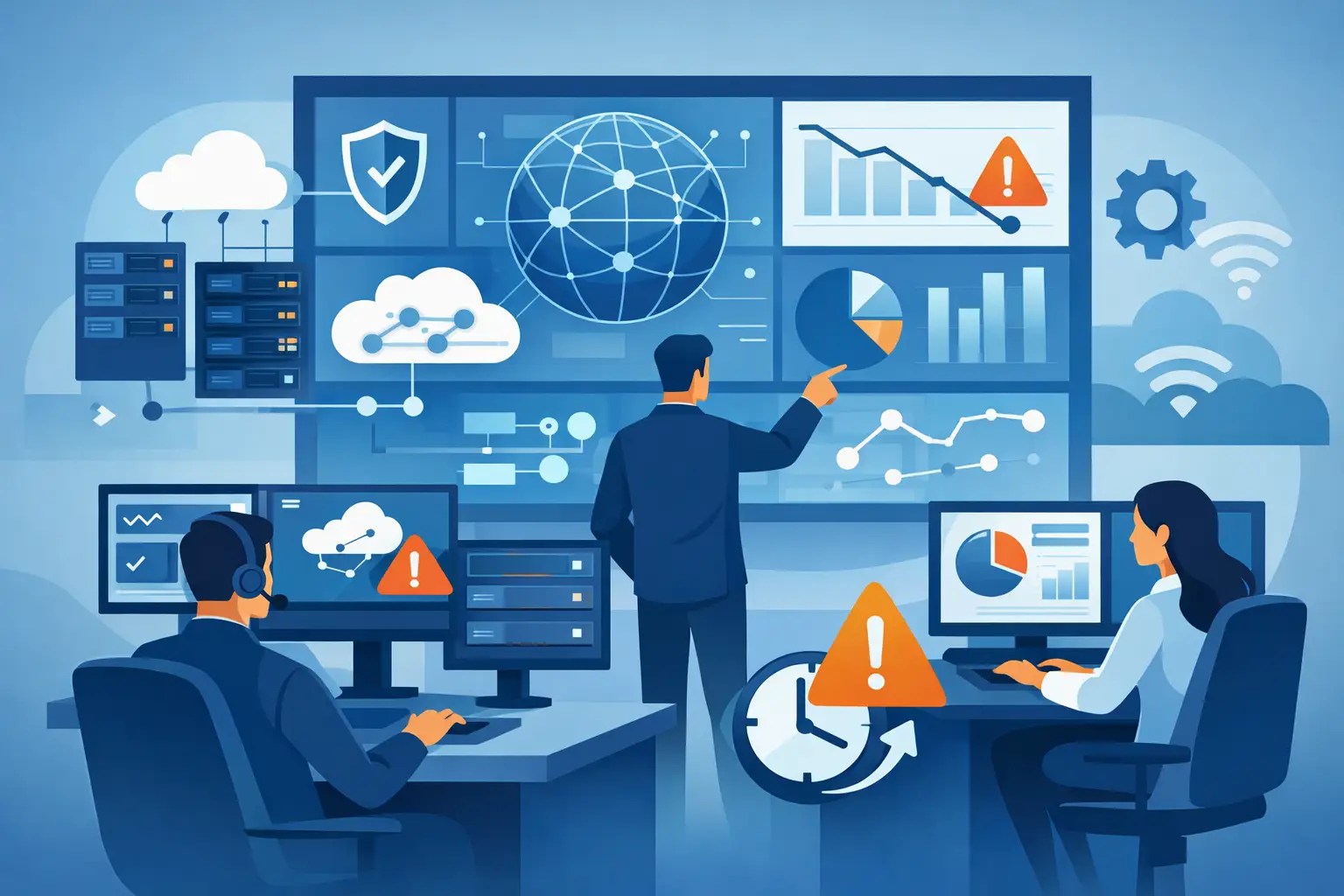
A Network Operations Center, or NOC, is the function responsible for watching the health and availability of core IT systems. Depending on the business environment, this can include servers, endpoints, firewalls, network equipment, internet connections, cloud applications, backups, and Microsoft 365 services.
The NOC monitors these systems around the clock and responds when defined conditions indicate a problem. That may mean a server is running out of storage, a firewall has stopped reporting, a site has lost connectivity, a backup has failed, or a critical application is unavailable. The response should follow a documented path: validate the alert, determine the business impact, resolve what can be handled remotely, and escalate incidents that require deeper investigation or on-site work.
This is different from traditional break-fix support. Break-fix support begins after a user notices something is wrong. NOC coverage is designed to detect and address many problems before they become a widespread interruption.
For an operations leader, the value is practical. Instead of wondering whether systems are being watched after business hours, there is a defined team, monitoring process, and escalation structure behind the environment.
Why 24/7 Monitoring Is Not Enough on Its Own
Continuous monitoring is a foundation, but monitoring software alone does not protect uptime. Most platforms can generate hundreds of notifications, including duplicate, low-priority, or informational alerts. Without people and processes to interpret those alerts, the business may still miss the few that signal a real outage or emerging infrastructure failure.
Effective network operations center services combine technology with operational discipline. Alerts need thresholds that reflect the environment. They need prioritization based on business impact. They also need clear ownership, so an alert does not sit unresolved because everyone assumed someone else was handling it.
Consider a storage alert on a production server. At 85% utilization, it may be a maintenance task. At 98%, it may threaten database performance, backups, and user access. A properly managed NOC does not treat every notification as an emergency, but it does recognize when a normal condition is becoming a service interruption.
The same is true of after-hours response. Some organizations need immediate action for every critical system. Others need monitoring, ticket creation, and escalation only when specific thresholds are met. The right coverage model depends on your operating hours, application dependencies, compliance needs, and tolerance for downtime.
The Systems That Need Ongoing Oversight
Businesses often think of network monitoring as checking whether the internet is up. In reality, availability depends on several connected systems. A stable network does not help if endpoint protection is failing, backups are incomplete, or Microsoft 365 administration is unmanaged.
A well-defined NOC scope should account for the systems that keep daily work moving:
- Network devices, firewalls, switches, wireless access points, and internet connections
- Servers, virtual machines, storage capacity, processor load, and critical services
- Business endpoints, patch status, device health, and security agent status
- Backup jobs, storage availability, retention failures, and recovery readiness
- Microsoft 365 accounts, licensing, access changes, and service administration
- Cloud platforms and line-of-business applications that support core operations
Not every device requires the same level of attention. A production server supporting accounting or customer service deserves a different response plan than a conference room display. Service levels should reflect actual business priorities, not a one-size-fits-all monitoring checklist.
How a NOC Reduces Downtime
Downtime is rarely caused by one dramatic event. More often, it is the result of smaller conditions left unresolved: a missed patch, declining disk capacity, an expiring certificate, a failed backup, or a network device that has been unstable for weeks. NOC operations reduce downtime by making these conditions visible and actionable before they affect the broader business.
Early detection prevents avoidable failures
Proactive alerts give IT teams time to act before users lose access. A low disk-space warning can lead to cleanup or capacity planning. Repeated connectivity drops can lead to a carrier ticket or hardware replacement. A failed backup can be corrected while a recent recovery point is still available.
Early detection does not eliminate every outage. Hardware can fail unexpectedly, internet providers can experience disruptions, and software vendors can have service incidents. It does reduce the number of preventable failures and shortens the time between a problem occurring and someone responding.
Defined escalation improves response quality
A critical alert should not become an email that waits until morning. NOC processes define when an issue is handled immediately, when it is escalated, and who receives communication. This is especially valuable for multi-site businesses, where one office may lose connectivity while the rest of the organization remains operational.
Clear escalation also reduces confusion during an incident. Business leaders need to know what is affected, what is being done, and what the next update will be. Technical teams need accurate documentation, access to the right tools, and an understood chain of responsibility.
Maintenance becomes part of operations
Monitoring identifies the work that needs to happen. Maintenance completes it. Patch management, antivirus updates, firmware reviews, account administration, and backup checks should operate as part of an ongoing service plan rather than as occasional cleanup projects.
There is a trade-off. Aggressive patching can introduce compatibility issues if it is not tested or scheduled carefully. Delayed patching can leave known vulnerabilities open for longer than necessary. A disciplined provider balances security urgency with change control and the needs of the business.
NOC Services and Cybersecurity Work Together
A NOC is not the same as a Security Operations Center, or SOC. The NOC focuses primarily on availability, performance, and infrastructure health. A SOC focuses on security events, threats, and potential compromise. The two functions overlap because operational issues can create security exposure, and security incidents can disrupt operations.
For example, an endpoint that stops reporting to its security platform is both a management concern and a security concern. Repeated failed login attempts may be a security event, but they can also indicate a user access issue that needs resolution. A ransomware event affects security, availability, backups, and incident communication at the same time.
For many small and mid-sized organizations, separating these functions across several vendors creates gaps. One provider may monitor the firewall, another may manage endpoints, and a third may handle backups. When an incident occurs, accountability becomes fragmented.
One Source Datacom brings infrastructure monitoring, day-to-day support, cybersecurity controls, backup oversight, and Microsoft 365 management into a coordinated managed environment. That model gives organizations a clearer path from alert to resolution, with fewer handoffs between providers.
Questions to Ask Before Choosing a NOC Provider
The right NOC relationship depends on more than a promise of 24/7 monitoring. Decision-makers should understand what is monitored, how alerts are handled, and where responsibility begins and ends.
Ask whether critical alerts are actively investigated or simply forwarded as tickets. Confirm the escalation process, response expectations, and communication methods for after-hours incidents. Review whether the provider monitors backup success and recovery readiness, not just whether backup software is installed.
It is also worth asking how the provider documents your environment. Current asset records, network diagrams, access procedures, and recovery plans shorten response time when an issue is urgent. If your business has compliance obligations, ask how monitoring records, patch reporting, access controls, and incident documentation support those requirements.
Finally, clarify the boundary between included services and optional coverage. Some businesses need full-time NOC operations, while others need standard managed support with enhanced monitoring for critical systems. The best fit is the one that aligns service coverage with operational risk.
Build an IT Environment That Is Easier to Manage
Stable IT does not happen by waiting for fewer tickets. It comes from consistent monitoring, maintained systems, tested backups, controlled access, and accountable response when conditions change. Network operations center services put those activities into a repeatable operating model.
If your team is learning about outages from users, discovering backup failures after the fact, or coordinating multiple vendors during every incident, the next step is to assess where visibility and ownership are missing. A clear review of critical systems, response procedures, and recovery priorities can turn recurring IT disruption into a manageable operational plan.